Showing posts with label SOA. Show all posts

Tuesday, 4 April 2017

Back from PaaSForum

So, and now we're back in business after a splendid week in Split, Croatia, to meet with about 200 great, enthusiastic con-colleagues from the fields of SOA and Weblogic. It was the yearly OPN Partner Community Forum, ran by the great Jürgen Kress. He did a formidable job to collect many informatic sessions on the latest news and products from Oracle. We could meet with product managers, eat  and drink with them. To my surprise I could shake hands with a Product Manager of PCS, with whom I worked closely on a try-out project at the end of last year.

It was at a great venu, Le Meridien, a short drive out side of Split. A nice hotel with fantastic views on the Adriatic Sea.

Last year on the 'OFM Forum' in Valencia, PaaS (Platform as a Service) as a 'MiddleWare Cloud' was an important subject. Oracle was heavily promoting  Cloud. This is why you could expect that this years forum was named 'PaaSForum'. And thus in one of the keynotes this was stressed by stating:


Now, our Dutch comedian Arjan Lubach made a video to introduce our country to president Trump:

So that made me introducing the statement:
Fun aside, I heard many nice things. To sum up a view:

  • On ICS side, there would be a REPL CLI script to move iar's (ICS Archives) between environments, created by the A-Team. I should look it up, but don't know if it already released it.
  • There was an introduction of the API platform, with also a workshop on it.
  • PCS and ICS are suggested to be combined into the Integration Cloud. Which would be a very logical idea, bringing much better, uniformed user experience. Because, at my latest cloud project, last year, we actually defined the practice to always integrate via ICS not directly from PCS.
  • There would also be a script, created by a Product Manager, to 'massage' BPM projects to transform them into a PCS compliant project. Hope to get my hands on that too, that could certainly be helpful. The otherway around would be not so bad either.
  • Then there was the mention of AI Apps, or Application Intelligent apps. Intelligence from verticals. This could drive PCS in a more intelligent way, based on knowledge from different verticals. 
But most interesting I found was the introduction of CMMN in PCS. Or otherwise put: Dynamic Processes in PCS. Where conventional BPMN processes in PCS run in a strict predefined way, with Dynamic Processes Case Management capabilities are introduced in PCS. Much like Adaptive Case Management in BPM Suite. However, build in a new way with a graphical modeller in the composer:

So here you see vertical lanes that represent phases in the process. In each phase you can define activities that can represent a Human Task, or for instance, a (sub-)process:
Activities can be repeatable, required or Manually Activated. Much like we can do in ACM.

Then using Decision rules you can decide under which condition the case is transferred to another phase, activities are activated or deactivated, etc. Or this can be done by the knowledge-worker self.


So I'm very much looking forward to get my fingers on this new functionality.

Another interesting new development is the introduction of Chat bots. They were so heavily mentioned and demoed, there hardly weren't any presentations without mentioning them. I almost felt I was one of the few that liked them, although the heavily relying on Facebook messenger. Even the, in my perception, breeding ground of chat bots, Twitter, wasn't free of criticism on the usecase of chatbots. I, on the other hand found a great non-functional use of chatbots: a text based adventure:

If we could combine PCS's dynamic processes with the Oracle Chat bot cloud service, we could develop a nice text adventure where you could chase beacons with in the process. Each phase in the process could represent a location, different processes can represent several areas on the map. But if we can have the process instances interact with eachother, for instance by registering their locations in a DBCS, or sending correlated signals (much nicer), then you could make it into a multiplayer text adventure. My colleague Rob introduced the idea to be able to upload pictures, of real-life locations. You could readout the Exif-data to check if the foto really represent a GPS-location.

So, that might be the next rolling-gag or app on the next forum in 2018, for which I already introduced the hash-tag: #ChatBotForum. In the aftermath of the week, at Jürgens afterparty, one of the others also mentioned text adventures. So, apparently, it wasn't such a far-fetched idea.

There's so much to think about, have it land, and much is already said. I'm looking forward to see how it all works out in the next year. The sun died on the #PaaSForum'17:


Working up to #ChatBotForum'18...

Wednesday, 24 March 2010

Postfix for handling mail in your integration solution

Sometimes there is a need for integrating with mail. You could say: that's easy, since we could use the notification service in BPEL as described here.
However, this solution requires that there is a mail-box to connect to. But what if you want to serve multiple (10s, 100s or even 1000s of) e-mail-addresses within a certain domain? Maybe multiple sub-domains within a certain main-domain? Then you would not want to create seperate mail-boxes for each address. That would give to much of an administration. Not only you have to create new mail-boxes, but also have activation agents for each of this mail-box. That would have an enormous performance pressure. So, what then?

In my previous post on handling email with SoaSuite (BPEL), I already mentioned Apache James as an email server. Nearly every Linux distribution also comes with Postfix. Postfix is a Mail Transfer Agent. It's not an e-mail server like James. It handles SMTP-messages. It will listen for SMTP-trafic and filter each message to determine if it has to be passed on to another MTA or to be handled locally. If a message has to be handled locally, it can be stored to local mailboxes or a local POP or IMAP server, for example. But it is also quite easy to let Postfix call a local script or executable. And that for mail-addresses that meet certain filter rules, like belonging to a domain. This script can then be used to have the message put/enqueued on a queue. The script can also be used to enhance the email messages with properties from the SMTP-envelope. I added that in the example too.

Now I'm not an e-mail server expert. But I had to figure out how to configure Postfix for this use-case. And although Postfix seem complicated at first sight, this turns out remarkebally easy.

Postfix installation
I choose Oracle Enterprise Linux 5 Update 4, as an alternative to Red Hat. But about any Linux-taste would do. Provided that it has a Postfix-pacYou might uninstall Sendmail (or unselect it in the package-options on install of the OS). This to prevent collision with the Postfix functionality.

Although you would do al the configuration as root (postfix runs as root), it is strongly advised to introduce an extra user for the message-handling. To own the scripts, etc.
In my setup the following folders are created:

Folder

Meaning

/etc/postfix

Configuration files and lookup tables

/usr/libexec/postfix

Postfix daemons

/var/spool/postfix

Queue files

/usr/sbin

Postfix commands


This is a quite common setup, but in other (Linux or Unix) distributions the folder locations might differ slightly.

Postfix Usecase
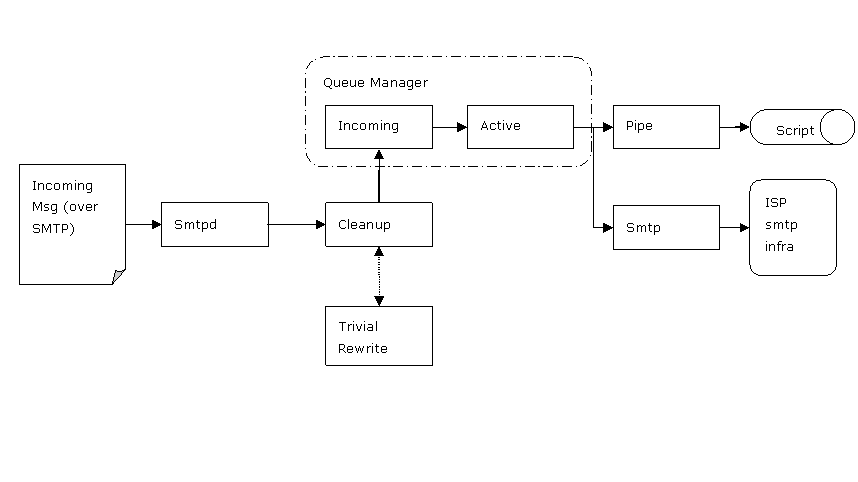
This schema provides an overview on how Postfix will work. Left Incoming (smtp) messages will be picked up by the Smtp-deamon. Then via "Cleanup" it will be handed over to the QueueManager, via the incoming queue. The Queuemanager will put the message on the Active queue. From there it will be picked up by either the smtp-service to forward the mail to the smtp-server on the infrastructure of your Internet Service Provider or your company. Using MA-records of the DNS-server it will determine to which smtp-server it has to be send actually.
In our use-case the pipe deamon is the interesting one. This is the one we're going to instruct to call a script.

Basic Settings
Hostname
The hostname command can be used to determine the fully qualified name. This is the one used by Postfix to determine the host. If this does not include the domain-name then the following command can be used to instruct Postfix what the FQN should be:
postconf -e myhostname=vmsmtp.darwin-it.local


Mydestination
This parameter can be left default. But if mail have to be accepted for certain domains and to be delivered using the local transport, set the following parameter in main.cf:

# 2010-02-03, M. vd. Akker: To have mail accepted for .darwin-it.local
mydestination = $myhostname, localhost.$mydomain, localhost, .darwin-it.local

For now leave it default:
mydestination = $myhostname, localhost.$mydomain, localhost


Network interfaces
To have mail from external networks, non-localhost, the inet_interfaces must be set in main.cf. In my case I run Postfix within a Virtual Machine. And I want to use my Thunderbird to send mail to Postfix. So first Postfix has to be told from which network-devices it should accept mail from. Since my VM is "hidden", for simplicity we accept mail from all network devices. But this can be narrowed down.


# RECEIVING MAIL

# The inet_interfaces parameter specifies the network interface
# addresses that this mail system receives mail on.  By default,
# the software claims all active interfaces on the machine. The
# parameter also controls delivery of mail to user@[ip.address].
#
# See also the proxy_interfaces parameter, for network addresses that
# are forwarded to us via a proxy or network address translator.
#
# Note: you need to stop/start Postfix when this parameter changes.
#
# 2010-02-10, M. van den Akker: Setup all interfaces for excepting mail.
inet_interfaces = all
#inet_interfaces = $myhostname
#inet_interfaces = $myhostname, localhost
#inet_interfaces = localhost


Specific domains to accept mail from are set with mynetworks parameters. To select sub-domains to accept mail from, change the mynetwork parameter to accept mail from your host for example.
# TRUST AND RELAY CONTROL

# The mynetworks parameter specifies the list of "trusted" SMTP
# clients that have more privileges than "strangers".
#
# In particular, "trusted" SMTP clients are allowed to relay mail
# through Postfix.  See the smtpd_recipient_restrictions parameter
# in postconf(5).
#
# You can specify the list of "trusted" network addresses by hand
# or you can let Postfix do it for you (which is the default).
#
# By default (mynetworks_style = subnet), Postfix "trusts" SMTP
# clients in the same IP subnetworks as the local machine.
# On Linux, this does works correctly only with interfaces specified
# with the "ifconfig" command.
#
# Specify "mynetworks_style = class" when Postfix should "trust" SMTP
# clients in the same IP class A/B/C networks as the local machine.
# Don't do this with a dialup site - it would cause Postfix to "trust"
# your entire provider's network.  Instead, specify an explicit
# mynetworks list by hand, as described below.
#
# Specify "mynetworks_style = host" when Postfix should "trust"
# only the local machine.
#
#mynetworks_style = class
#mynetworks_style = subnet
#mynetworks_style = host

# Alternatively, you can specify the mynetworks list by hand, in
# which case Postfix ignores the mynetworks_style setting.
#
# Specify an explicit list of network/netmask patterns, where the
# mask specifies the number of bits in the network part of a host
# address.
#
# You can also specify the absolute pathname of a pattern file instead
# of listing the patterns here. Specify type:table for table-based lookups
# (the value on the table right-hand side is not used).
#
# 2010-02-10, M. van den Akker: Setup for accepting mail from CMI and localhost.
mynetworks = 192.168.192.0/28, 127.0.0.0/8
#mynetworks = 168.100.189.0/28, 127.0.0.0/8
#mynetworks = $config_directory/mynetworks
#mynetworks = hash:/etc/postfix/network_table

Where 192.168.192.0/28 should be replaced by the address-range of the host(s) from which you want to be able to receive email.

Start and stop postfix
Postfix can be stopped by:
[root@vmsmtpserver postfix]# postfix stop
Postfix can be started by:
[root@vmsmtpserver postfix]# postfix start
If it’s not already running.

After making changes to the configuration, Postfix has to be told to reload the configuration:
[root@vmsmtpserver postfix]# postfix reload
postfix/postfix-script: refreshing the Postfix mail system
Incoming e-Mail
Postfix will have to be configured that *.darwin-it.local will be seen as a domain for virtual mailbox addresses. The virtual transport has to be configured that these messages are handled by the pipe-deamon to call an external script.

We'll instruct Postfix also to enrich the smtp-message with two Custom properties:
  • x-envelope-to: Recipient list from the SMTP-Header
  • x-envelope-from: From-email-addres from the SMTP Header
Actually we implement the enrichment in the script. But Postfix will pass these properties as parameters.

Create a transport
To have incoming mail for .darwin-it.local transported to the script, a new transport has to be configured.

This is done in the master.cf file:
# 2010-02-10, M. van den Akker: Setup transport routescript for passing message to a bash-script
routescript   unix  -       n       n       -       -       pipe
flags=FDq. user=smtpuser argv=/bin/bash -c /home/smtpuser/routescript.sh -s $sender -r $recipient -q $nexthop -

Here a new transport is created, named “routescript”. It refers to the “pipe” deamon.

The “flags=FDq” denote that the From and destination addresses from the header are added to the header.
Change the following if necessary:
  • The user denotes the unix-user that is used to run the script. In this case the unix-user “smtpuser” is used. Change it to the proper user (other than “root” or “postfix” ) .
  • argv: denotes in this case that a bash script is called. Bash is called to run the routescript.sh script, that is placed in the home folder of the smtpuser. Change the path according to the correct location of the given script.
  • The next parameters are parameters for the routemq.sh script:
    • -s: the sender of the message, $sender refers to the from-address on the smtp-envelope
    • -r: the recipient(s) of the message, $recipient refers to the to-list on the smtp-envelope
    • -q: the queue on which the message has to be put. Our script was designed to queue the message on IBM mq. The property $nexthop refers to the nexthop property in the transport map. Having used this parameter to denote the particular queue enables us to change only the transport map if a queue is changed. Or reuse this transport for different queues in different transport mappings. This is a nice way to pass info about the actual/technical transport channel to be used.
Create transport map
To route the '.darwin-it.local' domain to the script a transport map has to be made in the transport file.

Add the following line to the transport map file:
# 2010-02-10, M. van den Akker: Setup transport routescript for handling darwin-it.local-messages.
.darwin-it.local routescript:queuename
Where queuename is the queue that is used for the smtp-messages. This is the 'nexthop'-parameter where the $nexthop property in the master.cf refers to.

After having changed the transport map file, it has to be compiled into an indexed binary using the postmap tool. So execute the following command:
[root@vmsmtpserver postfix]# postmap transport
Define transport map
To have the transport map used by Postfix, add the following lines to the main.cf :
# 2010-02-10, M. van den Akker: use transport map
transport_maps=hash:/etc/postfix/transport

Routescript
Make sure that the routescript.sh as given in the appendix is placed on the location as defined in the master.cf above. In the example above it is: /home/smtpuser/routescript.sh
Make it owned by the user that is used by Postfix to execute the script (smtpuser).
Then make the script executable:
[smtpuser@vmsmtpserver postfix]$ chmod +x routescript.sh


The actual script as an example is given at the end of this article.

Outgoing e-Mail
All outgoing e-mail should be forwarded to your companies or ISP's smpt-infrastructure.

To do so set the relay-host parameter to the particular smtp-server in main.cf:
# INTERNET OR INTRANET

# The relayhost parameter specifies the default host to send mail to
# when no entry is matched in the optional transport(5) table. When
# no relayhost is given, mail is routed directly to the destination.
#
# On an intranet, specify the organizational domain name. If your
# internal DNS uses no MX records, specify the name of the intranet
# gateway host instead.
#
# In the case of SMTP, specify a domain, host, host:port, [host]:port,
# [address] or [address]:port; the form [host] turns off MX lookups.
#
# If you're connected via UUCP, see also the default_transport parameter.
#
#relayhost = $mydomain
#relayhost = [gateway.my.domain]
#relayhost = [mailserver.isp.tld]
#relayhost = uucphost
#relayhost = [an.ip.add.ress]
Restart Postfix
After having made the necessary changes above it is important to restart (stop and sart) Postfix. Just doing a reload of the config will probably not suffice.

Conclusion
It took me some time to understand Postfix. I was quite overwhelmed by the options. And it took me some time to figure out how to configure it for this particular usecase. Where I had to consult a co-worker (the one that sort of made up this use-case; thanks to Hugo). But as with most other things: after all it turns out to be simple. And it might be useful for many other cases.

Appendix: the routescript.sh
Below the script is given to be called by Postfix to route the messages. This script is designed to either output the message to a file or to an IBM mq client. The mq-client has to be installed from a licensed installment of IBM. IBM also provides the MA01-support pack, in which for several OS'es an compiled executable is provided. This executable (simply called 'q') provides a commandline interface to the IBM mq-client. The mq-client can put the message to a queue, but also to standard out. This is handy for testing, where no mq-client is available.

There are 2 lines to edit:
Q=~/bin/ma01/q : give here the proper path the q-executable from the MA01-support pack
fi|"$Q" -O "$QUEUE_NAME" : here the output of the if-block is outputted to the q-client using the queue-name. If the queue is not available in test-environment this will give an error. For test purposes it might be usefull to comment this line use (uncomment) either the line '#fi|"$Q" -s' to have the q-client output the message to STDOUT, or '#fi>$FILENAME' to have the output directed to file.

The script will exit with the result code of the last command, which is the q-client. If that one fails, the script with exit with the result-code telling Postfix to consider the call failed. Postfix will consider the message undelivered and retry it later.

#!/bin/bash
###################################################################################################
# Route messages.
# Script to route an email message, read from pipe and output it to a channel.
#
# author: Martien van den Akker
# (C) januari 2010
# Darwin-IT Professionals
###################################################################################################
#Declartions
E_WRONG_ARGS=85;
NUMBER_OF_EXPECTED_ARGS=6;
FILENAME=/tmp/routemq-`date +%Y%m%d-%H%M%S.%N`
Q=~/bin/ma01/q
TRUE=1
HDR_ENV_FROM="x-envelope-from"
HDR_ENV_TO="x-envelope-to"

#Function to display usage
usage(){
SCRIPT_PARAMETERS="-r receiver -s sender -q queuename";
USAGE="Usage: `basename $0` $SCRIPT_PARAMETERS";
echo $USAGE;
}

# Check Arguments
if [ $# -lt $NUMBER_OF_EXPECTED_ARGS ]
then
usage
exit $E_WRONG_ARGS;
fi
until [ -z "$1" ]
do
case $1 in
"-s") SENDER=$2;;
"-r") RECEIVER=$2;;
"-q") QUEUE_NAME=$2;;
* ) usage;
exit $E_WRONG_ARGS;;
esac;
shift 2;
done;

#echo header variables and cat stdin to output.
#Edit next line to give the proper full path to the “q”-executable from the MA01-support-pack
if [ "$TRUE" ]
then
echo "$HDR_ENV_FROM: $SENDER"
echo "$HDR_ENV_TO: $RECEIVER"
cat -
fi|"$Q"  -O "$QUEUE_NAME" #  uncomment to output to $QUEUENAME (Comment previous line)
#fi|"$Q" -s # only output to stdout
#fi>$FILENAME #uncomment to output to filename

exit $? #Exit with result-code of last command, which is the "q" command.

Thursday, 29 October 2009

Next Generation SOA

Last week I was on the SoaSymposium in the WorldTrade Center in Rotterdam. The theme of this years episode was apparently "Next Generation SOA". On before hand I wondered what they meant with it. Apparently I missed the blog of Anne Thomas Mane that stated that SOA is dead.
It reminded me of my own blog post on the subject. In that blog-post I opposed to the statement of soa-experts of a Dutch ICT weeklet, where SOA was declared dead in favour of EDA. Because I could not remember exactly on what article I reacted back then, I got a little anxious to get in touch with her. But the reason that Anne declared SOA dead was because of the hype that rose around the acronym by the vendors, customers and media. The acronym got so loaded with pre-assumptions that it did not stand for what it promised anymore. And so many SOA projects fail because customers think they could buy the magic box of a vendor that solve every problem. Or the magic hat of the Pixar Magician Presto. And of course vendor's would love to sell this to them. If they could... To declare SOA dead as a hype with all its false promises and focus on Service Orientation, I second completely. You can't buy or sell SOA, neither as a "Silver bullet", nor as a "Magic hat". It reminded me on this company that would sell an integration product on a blade-server. Put it in a rack and your ERP's are integrated. Yeah, right. I assume that the actual implementation is less magic.

Thomas Erl and Anne had a session to cast out the "Evil SOA" and welcome the "Good SOA". I liked the music of Mike Oldfield, but after a while it got too pressing and looped through the very first part of Tubular Bells, that it almost cast me out. But it got me the nice Soa Patterns book of Thomas Erl.

I think with Thomas and Anne that Service Orientation is very important and grow in importance. But together with EDA. Well actually, I think EDA is not an architecture on it self. As with Soa and cloud: if we're going to hype this idea we fall in the same faults again. But as stated in my former post, I think that Events and Services are (or should) two thightly coupled ideas. No loose coupling here. You use these ideas to loosely couple your functionalities. But Services are useless without events. And events (either coming through an esb or as a stream) are quite useless without services that process them.

For the rest it was a good event to network. Met a few former colleagues and business-partners. Or people with I had co-acquaintances. I saw a nice presentation of Sander Hoogendoorn and Twan van der Broek on agile SOA projects combined with ERP. I'd like to learn more on that.

Friday, 5 December 2008

EDA the successor of SOA?


Today I read the remarkable article in the Computable that according to Gardner EDA (Event Driven Architecture) will be the successor of SOA (Service Oriented Architecture). That would suggest that EDA and its technology is newer than SOA or that EDA tools will replace the current SOA-tools. Well, I'm not that into the History of ICT. But about three years ago Oracle introduced their Enterprise Service Bus as part of the SoaSuite. You could consider the ESB as the succesor of Oracle's InterConnect in J2EE technology. Remarkable also is that you can find Oracle Workflow's Business Event System parts in the ESB technology. The Business Event System (the name sais it all) is part of Oracle Workflow since version 2.6, that was introduced in 2001 if I'm right.
Oracle Service Bus (fka. BEA's AquaLogic Service Bus) was introduced in 2005. And there are serveral other service busses maybe with an even longer history.

So Busineess Events could be (and should be) part of our applications since a long time. In fact Enterprise Application Integration (another Three Letter Acronym or TLA), is about firing and receiving business events from applications.

I believe that EDA does not succeed SOA. In fact SOA is about Services and Services on their own are not usefull. Services are triggered with an information object. And this infact is an event. Connecting Services in to a business flow (what we call "orchestration") is about passing Business Events between Services folowing a Business Process. Nowadays we tend to do that using BPEL or BPMN.

Therefore I would state that SOA = EDA + BPM. I must confess that I did not make that up on my own. Since I'm a former Oracle Employee, this is what I've learned from the positioning of Oracle's toolstack onto SOA.

Having a Service Bus is not a replacement of your SOA toolstack but a very valuable addition to it. It's a very good idea to have a Service Bus abstract your services from your Business Process. That makes it easier to do things like aggregating services, replacing services, transformations from Enterprise Business Objects to Application Business Objects, etc. But this article is not about the value of an Service Bus. For that I could write a complete separate article.

Read also this previous article.

Monday, 1 September 2008

Wrap-Up of the SOA Partner Community Forum August 2008

Last week I went, as many others, the Oracle Soa Partner Community Forum at Cap Gemini in Utrecht, the Netherlands.

It was an interesting week. Although I must say that for me the most interesting was that I did not hear any significant different than I learned past two weeks. I wrote an article with some follow ups recently about the BEA acquisition of Oracle. The original one is being resyndicated here, what is something that I'm pretty proud of (sorry). So I'm quite pleased that what I stated before is still standing.

But I want to add some conclusions to the story.

ESB
There is some discussion about the position of the Oracle ESB. Is it going to be BEA's AL Service Bus? But what about the Oracle SoaSuite ESB? Well, I learned now explicitly that when you search for a standalone ESB, than the Oracle ESB, fka AquaLogic Service Bus (BEA's Service Bus) is promoted. The Oracle ESB is going to be around as a mediator in the SoaSuite 11g. I would certainly take good notice of the pricelists and discuss with your Oracle Sales Rep. Because, I would be curious about the pricing of the ESB's. Probably you would have to pay for the new Oracle ESB, while, if I understood correctly, when you would use the current SoaSuite10g ESB standalone (without BPEL, OWSM, etc.) you get it free. Provided that you have an Enterprise Edition License of Oracle AS 10g. So I would wonder if the SoaSuite Mediator (the former SoaSuite ESB) in 11g will have a separate line on the pricelist.
Since I'm a technical consultant, and the pricing-policies of Oracle (and probably other vendors) is something like "higher-math" don't take my word for it.

AIA and SoaSuite10g/11g
Oracle's Application Integration Architecture was also promoted during the Forum. I think it's a very interesting subject. Also when you can't use a pre-built Process Integration Pack (PIP) the AIA Foundation Pack could provide you a lot of plumbing, like error-handling, that prevents you from having to break your brains on. Unfortunately I don't have experience in implementing a custom integration using AIA Foundation pack , yet. But I would recommend it only if you plan to build a large integration from scratch. If you've done a lot allready with the SoaSuite or you plan to do just some small ESB integrations than it would probably be too expensive or at least take too much time to learn and to put in place. Than you'll be faster with a doing an own implementation. But it mainly depends on your requirements.

One thing I couldn't get asked, although I raised my hands several times, is how AIA is going to embrace SoaSuite 11g. AIA now heavily depends on the capabilities of SoaSuite 10g. I'm curious on how AIA is going to use SCA for example. But there are also several PIP's ready. Migrating them to SoaSuite 11g will gain a lot of knowledge that other SoaSuite 10g customers will be interested in!

Another thing I read between the lines is that SoaSuite 11g is not expected at OpenWorld but somewhere in Fiscal Year 09. That is somewhere between now and may 31st 2009. Together with the fact that AIA is still relying on 10g, I dare to say that SoaSuite 10g will be around for quite a while. Don't be affraid to invest in SoaSuite10g. I think that it is a good, reliable product.

Weblogic Application Server
On Thursday I attended a workshop on Oracle WebLogic 10.3. Unfortunately the labs were mainly about creating some J2EE projects using Weblogic Workshop (which is a packaging of Weblogic addons on Eclipse). Although it was nice, and although I lost time strugling with a VMware image, I was mainly interested in how Weblogic was different from Oracle AS. It was nice to see that, from my perspective, Eclipse and JDeveloper are more or less the same in user-experience and functionally. Eclipse looks nice and I was pleased to have somewhat the same user-experience I have with JDeveloper. Of course this is a matter of taste, some pure-java-adepts might disagree. The thing is that JDeveloper will be Oracles main J2EE development platform. And that's fine with me.

Regarding Weblogic, I haven't been able to see in what way it's better than Oracle's OC4J. Both support the J2EE and in theory they both should support properly designed J2ee-applications. In fact most of the Oracle Soa products are interchangeable, running on both OC4J and Weblogic. So the differences will be in the way reliability, manageability and grid-functionality are implemented. So I was browsing a little through the html-interface. The labs relied on the starting and stopping of the Weblogic J2EE server from Eclipse. More or less like JDeveloper that is shipped with a standalone OC4J container. I was not too enthousiastic about the web-interface. I couldn't find the particular JSP's and Webservices of my deployed applications (I found the EAR's). In fact I ran into a locking problem between Workshop and the Weblogic web interface.
I'm very curious about the Enterprise Manager integration, the starting and stopping and maintenance of the Weblogic Server. But I think I'll wait until Oracle comes with a Universal Installer that installs SoaSuite11g with a WebLogic Server. Beause I think that's the moment it is interesting for customers that are new to Weblogic too. About the same thing more or less counted for BPEL Process Manager in the past.

Oracle Coherence
The last thing I want to remark from the Soa Partner Forum was the presentation of Dave Chappel about Oracle's Data Grid, implemented by Oracle Coherence. I heard the "expanded" presentation on the OGH meeting in De Meern on monday eavening first. To be honest, I took some time to "land" with me. I understood the principles, but I struggled with the consequeses for the implementation of Services (BPEL PM, ESB, Webservices). But it is a very interesting technology. Not at least because it is not only a Data grid but a Compute Grid as well. You can store data (like parse xml-messages) in the grid but also let the Grid perform methods on it. See also the blog of Lucas Jellema on it.

It occurred to me though that it is interesting for pretty specific implementations however. There is quite some custom-building involved. At the moment I think it is primarily interesting when having to do orchestrations with a lot of data enrichment and data-mutation based on business rules using custom services. It would be more interesting in the future when the SoaSuite can be plugged on to Coherence in a way that BPEL PM, ESB and Oracle Rules Engine is using the same data-objects in Coherence. Coherence could be used as a high-available and highly-performant (since in-memory) dehydration store.

All togehter it is a product that you'll going to here a lot more of I ex[ect. Something to watch out for, because it will grow in importance. Especially with an increased integration with the other Oracle products.

Tuesday, 8 July 2008

New: the PoPoToPi!

The very main reason for me to write this blog-entry is to introduce a new word: Popotopi. I would love to see this home-made word pop-up in upcoming discussions over the world. To be honest, I used another word for it: PoJo: Plain Old Java Object. The word PoPoToPi means Plain Old Point To Point Interface. I like the word, because of its cadens, how it rolls over your lips.

Ok, another reason then: to explain one of the questions I'm currently involved in. My current customer has just celebrated the first aniversary of their EAI department. That means they have been busy with integration for quite some years. Mainly on Tibco. But now they have some projects going around introducing two other ESB/Soa platforms, one of them being Oracle SoaSuite. This drives them to think about integrating the integration platforms. How to exchange services, what is the scope of one integration environment, how to define bridges etc.

Looking into this I also discovered that they have several environments of their current Tibco Platform, because of having several domains. One of the colleagues I have in this department is catagolizing the services of one of the domains. His impression is that about 80 percent is just point to point. Although most of them are neatly defined using a so-called Canonical Data Model.

Having a Canonical Data Model is nice. It's just like the Hub-and-Spoke architecture of Oracle's Industrial Archeology Artefact: InterConnect. InterConnect was technical not a very sophisticated product. But the whole idea behind InterConnect I do like still. The Common View in InterConnect, that is the Canonical Data Model, is the abstraction on message level between end-points. It is based on Logical Entities on which you map the physical entities of your Enterrpise Information Systems (EIS).

But if you conclude that 80% of your integrations is point to point then you should think about how successfull you were in implementing EAI (Enterprise Application Integration).
A coupling is point-to-point if the two end-points are not re-used anywhere. Although the coupling uses a Canonical Data Model, the business event that is based on the CDM is not re-used. The reuse and thus the advantage of this approach only pays-off when you subscribe another end-point to the business event in the hub, if you have another application publish the business event or when you decide to replace one of the end-points without modifying the CDM.

Although the couplings are based on a CDM it is very interesting to compare the different CDM's (the message definitions) of the different integrations. As said: a CDM should be based on logical entities. This Logical Entities should also be reused over the different integrations. For example: an order in the "CreateOrder" integration should be the same in the "UpdateOrder" integration.

Drilling down in to the Logical Entities, it should also be interesting to reuse parts of the Logical Entities. For example: the address of a person, a customer, a supplier or an organization, be it a home, billing or shipping address, should be allways the same in structure. Actually a person being a customer or a supplier or a TradingPartner's contactperson is allways the same in structure.

It would be very interesting to see to what extent the standardization on CDM's is put through. Honestly, it would surprise me if there are not more then one definition of whatever Logical Entity in the different interfaces.
Every coupling, integration is defined and implemented in different projects. Only if a project-member does know of the existance of a reusable artefact and/or if there is budget to make artefacts generic enough, a project might leverage the advantage of EAI or feed the potential of it.

If every Logical Entity is neatly defined only once ever, especially when it is describe in a central library of artefacts, that would be great. Then you could say that you were quite succesfull in implementing a sufficient EAI.

If not, you can't speak of a succesfull, efficient EAI. Then, to me, you have implemented Popotopi's on a modern platform, where so-called services are not much more then simple building blocks (not services). But ask yourself and decide for yourself if it was worth the investment.

It is too bad, because a good EAI with uniquely, accurately, correctly and completely described buildingblocks, triggers, CDMs and message-object-mappings could be a very good base for the implementation of a SOA. Where a buildingblock could really be a service, a trigger could really be a Business Event in your Event Driven Architecture and the CDM's and mappings a base for your Enterprise Business Objects with their transformations.

I used to do Quick Scans on the performance of Custom Development Applications. It would be nice to do such a scan on EAI implementation to see what the impact on the implementation of SOA is in such a case. Or at least to think about it along with a customer.

Friday, 16 May 2008

My Vision on SOA, part 2.

I just realize that maybe I have to explain my earlier post on my vision on SOA. I stated that it is all about: "Don't postpone to tomorrow what you can do today".

A few years ago I had a discussion with a colleague that resulted in an article in our consulting-magazine. He asked me if I would use InterConnect for an interface that processes 1000000 records in batch every night, were the receiving application is not interested in the records real-time.
But then your only argument to use an EAI-tool like InterConnect, Tibco or ESB that the receiving application needs the application realtime.

But it results in a costly batch that has to be maintained. The batch has to fit in the batch-window. There is no reuse of the code (transformations and data-enrichments in the batch). And also the providing application is pressurized because of requirements of the remote application. When you're able to get the change-events in the source application in real-time then you have all the information at hand at the moment the event occurs. Then you can do the transformations and enrichments at that very moment. You could do that asynchronously when these actions would cause the End-user-session to be less responsive.
Doing so you can subscribe multiple applications/services to the events. Also after processing the event the publishing application got rid of the responsibility.

If your receiving application is not able to get the mutations real-time, you can collect the mutations in a staging table. And then you only need a very light batch that just processes each mutation from the staging table in the receiving application. Since all the transformations and enrichments are done at real-time the mutations are in a processable state for the batch.

When you are to soa-enable an enterprise that uses packaged apps like Oracle E-business suite or conventional (Designer/Developer) custom-apps than you may have to break up the conventional way of working with batches. Possibly you can copy and paste transformation and data-enrichment code from the batches. But big chance that you have to rebuild it with technologies as XSLT.

When you have to build or maintain a custom-app or you work as a developer at a packaged-app-provider then also keep this in mind. Try to work event-driven. See that on every mutation event you're able to put a message on a queue (for example AQ) or publish an event to an ESB-product (Oracle SoaSuite).

Oracle Workflow had the Business Event System, which is a really nice system for publishing and subscribing to events. It is AQ based and available with every main product of Oracle (database, AS). It mainly executes in the database so for custom Forms applications, especially when they're based on Designer/Headstart/CDM Ruleframe, the ideal way to expose change-events asynchronously.
Very unfortunately Oracle decided to de-support Workflow (and thus BES). It is supported as long as the product that it's shipped with is supported. So as long as Oracle DB 10g or Oracle AS 10g is supported you can use Workflow/BES.

Actually it is quite remarkable that they de-support it. Because BES used to be written in Pl/Sql but in the very latest release (2.6.3 or 2.6.4 that shipped with 10gR2) they re-build it into a J2EE container! I wonder why they did that, because soon after that the Statement of Directoy noticed the de-support. I have two possible explanations:
  1. E-Business Suite still ships with embedded workflow. Release 12 is OC4J based (R11 is still based on the formally for customers desupported old Oracle 9i Application Server version 1.0.2.2). In R12 the Oracle embedded Workflow will still be available and so the BES can be J2EE based. Also it makes it simpler to have Java-calls on events. In 2.6.2 it used some kind of D-tour-solution from Pl/Sql to java.
  2. Did you ever took a glance at the datamodel of Oracle SoaSuite ESB 10.1.3? You will see some tables of ... indeed: Oracle Workflow/BES!

Wednesday, 2 April 2008

My vision on SOA

One of the most typical Dutch cultural exposings can be found on grandma's toilet. They're the Toilet-Tile-Wisdoms.
In the end of 2006 I've been asked to give a presentation on SOA in the Public Sector. There are many publications on SOA. They're all talking about (web)services, orchestration (BPEL) and maybe ESB. But at that presentation stated that I think SOA is really about one basic wisdom:
Tomorrow night I'll explain at our companies technite. But I'm happy to elaborate on this at your organization as well. Please contact us via www.darwin-it.nl.